
Dreaming without sleep in the cold.
Snowstorms and the 100 lives of Wifredo Lam

It’s been a kind of cold I remember but haven’t seen a while. When I see the winters of my childhood I imagine us trudging through the same snow for weeks, dragging it in and out of our homes in clumps, but in the modern world it always seems like the sun or the subway heat tend to send it back to oblivion.
Last week the sky took home a new single day trophy for the highest recorded snowfall, measuring over a foot in New York City. This preceded a record cold front with temperatures between 3 degrees F and a high in the 20s, all well below freezing, which as it turns out is the comfort zone of a record snowfall. The snow isn’t that pretty a week and a half later. The plows stack it so that a foot becomes 6 feet of impenetrable wall around your apartment building. Without the sun’s help the walls gain the colors of a NY that is usually hidden against the backdrop of ashphalt. Moments of sunlight melt these frozen monstosities just enough to form sheets of ice under your feet, garbage is stacked up, the subway station floors are slippery as if greased. In very limited special circumstance, the city burns the snow with fire where needed or uses cranes to clear the streets for foot traffic. But mostly that doesn’t happen on my block.
I went to MoMA despite all of this and trudged instead through the archives of the life of Wifredo Lam.
Lam was Cuban-born from a Chinese father and a complicated ancestry on his mother’s side that seemed to gain depth as it passed through generations like an agglomerate mass of every form of human that had stepped on the island. Mixed parents, mixed grandparents, Congolese, Spaniard, Native, Colonial, Criollo. As humans go, he was a special order, but In Cuba, he was very Cuban. With all those different rhythms in his head it probably isn’t a surprise he started painting. He studied at Academia Nacional de Bellas Artes in Havana, but he left left the island for Spain as a colonial subject hoping to master its art traditions.
Where his new mentor in Madrid pushed a rigid Spanish realism, Lam excelled, a master drafstman, but found the conservative practice suffocating.
He ignored the High Renaissance masters at the Museo del Prado and fed his brain instead on Bosch’s surrealism and grotesquery, Bruegel ‘s crowded compositions and the elongated distortion of El Greco. He began also to frequent Madrid’s museum of Anthropology, where he was introduced to African and Oceanic art.
He found love and married in Spain, his new wife Eva gave him a son, Wilfredo, but the family lasted just over a year before he lost both to tuberculosis.
You can see this tragedy darken his work at the outset of the 1930s. He begins to reject the lucent, academic portraits that had paid his bills.
Lam flees his family’s home in Madrid and moves to a jagged, Northern mountain town in deep isolation, and there discovers Matisse and Picasso through fakes and reproductions. As a poor kid who often encountered his interests through knockoffs in Chinatown, that part of the story really lit up my internal circuitboard. That inspiration’s path is amorphous and oblivious to proper channels, separate from the artist that made them and the eye of the scene that responds. That sometimes the idea of a thing is so powerful it can spread even through trickery. In those mountains, Lam is stuck with low-res training. He can’t learn from the brushstrokes of Matisse, so he learns the logic of the shapes. This keeps him separated from these influences even later as he starts to cross their paths. But encountering their work, even in pictures, giveshim a pass to stop painting like a 17th century Spaniard.
As the Spanish Monarchy falls, Lam’s social interests begin to radicalize. He moves from Academic circles towards a more romantic and increasingly anti-fascist corner, a Spain of poetry and ideas. In the mid 30s, when a coup splits the country nearly down the middle, rather than flee he digs in and fights fascists in the Spanish Civil War before falling ill to chemical poisoning from handling munitions.
In a sanatorium outside Barcelona, he’s forced by that illness to give up war and go back to painting. This new Lam is somber and intense. His most famous work of the period, La Guerra Civil (the Civil War) is commissioned by the Rebublican Government. It represents a transition, his academic practice shattering under the trauma of his reality. It depicts a wall of suffering, the depth of his old work flattened, his subjects stacked like towers made of cursed bodies and geometric spikes that split through the painting. It hangs at the Paris World’s Fair the next year with Picasso’s Guernica.
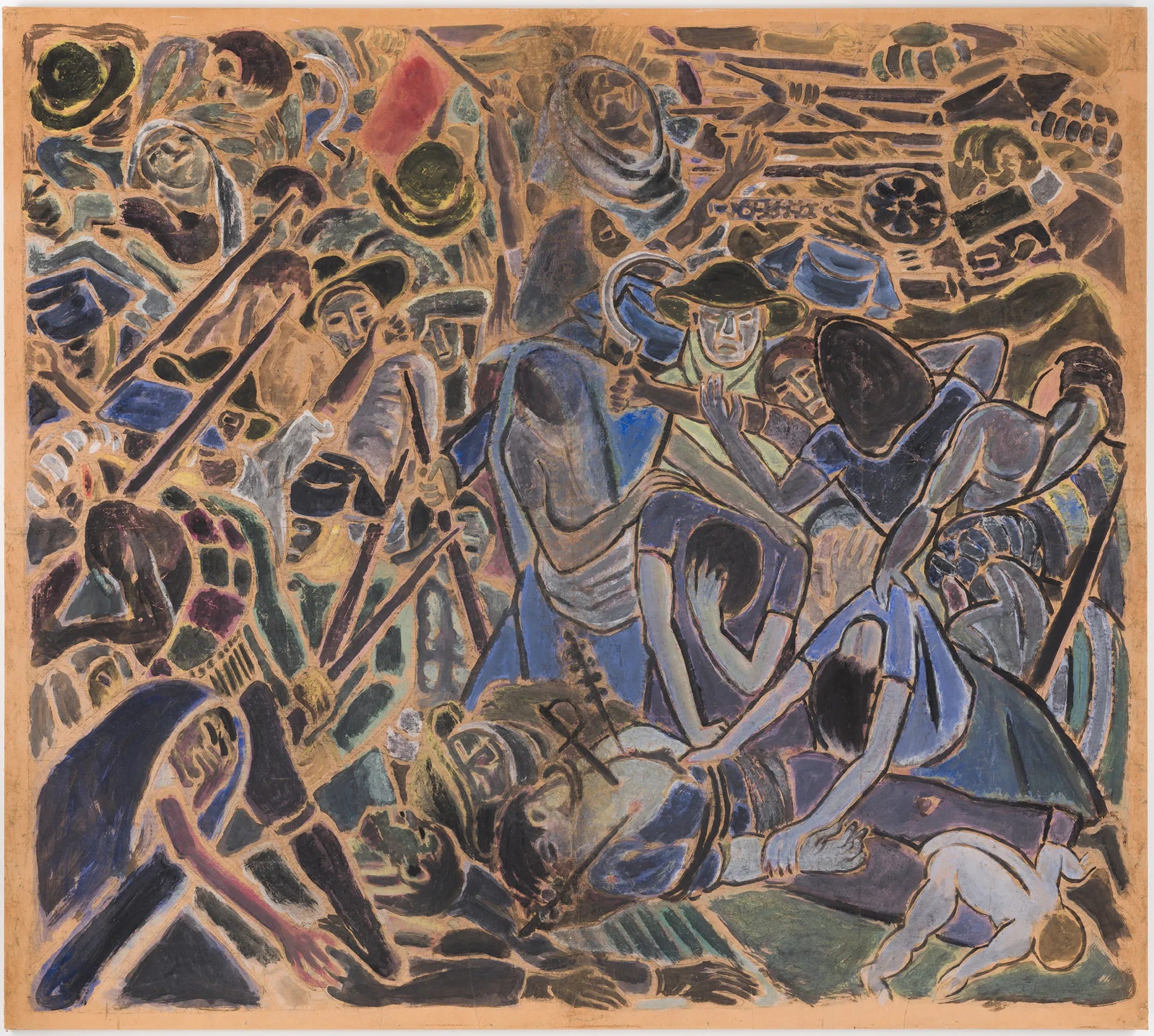
As Barcelona’s instability grows and its edges wither under Nationalist fire, Lam’s sculptor friend Manolo writes a letter of introduction to Picasso in fear Lam’s talent will disappear under the bombs.
Lam arrives in Paris, scarred from his losses, weak from one war and about to meet another. Upon their encounter, Picasso immediately adopts him, insisting they share blood in their veins. Through Picasso, Lam meets the sacred high council of modernism, Miró, Léger, Braque and expands Lam’s exposure to African masks and totems.
Lam follows André Breton into surrealism and starts illustrating his poems before they flee Paris to Marseille to escape the Nazis. Trapped in Marseille with Breton and a safe-house full to absurdity of other artists and intellectuals, Lam chips even further away at his formalist roots with collective drawing games, the group stacking their styles to build a Frankenstein none of them can control.
Lam and Breton are forced to flee again, leaving Marseille and WWII on the Capitaine Paul-Lemerle, a ship later legendary for its unusual manifest of famous artistic figures. Detained by the Vichy French in Martinique, Lam is interned at Trois-Îlets with the poet Aimé Césaire. Césaire’s Negritude moment forms the last piece of the framework for Lam to embrace his Black identity as a revolutionary force.
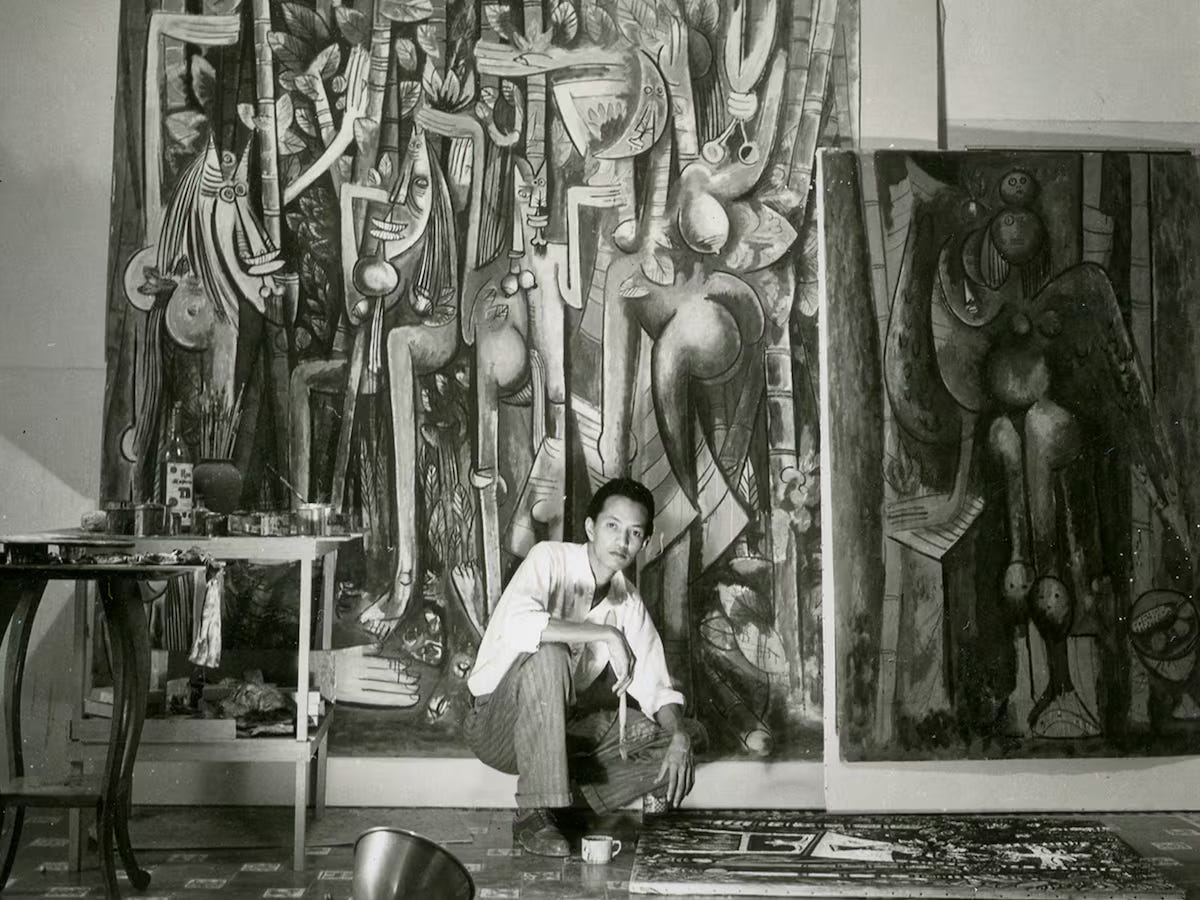
18 years gone, Lam abandons the growing dangers of Europe and returns to pre-Castro Havana, now run by American mob interests, to find its afro-Cuban roots and rituals on display as a tourist attraction.
The scalding Cuba of the Summer of 1941 is the pressure cooker that leads to Lam’s most famous painting: La Jungla (The Jungle). It features an industrial sugar cane field presented as wild and teeming with Femmes-cheval, hybrid of woman and horse with stylized crescent masks reminiscent of the African and Oceanic faces he’d been studying.
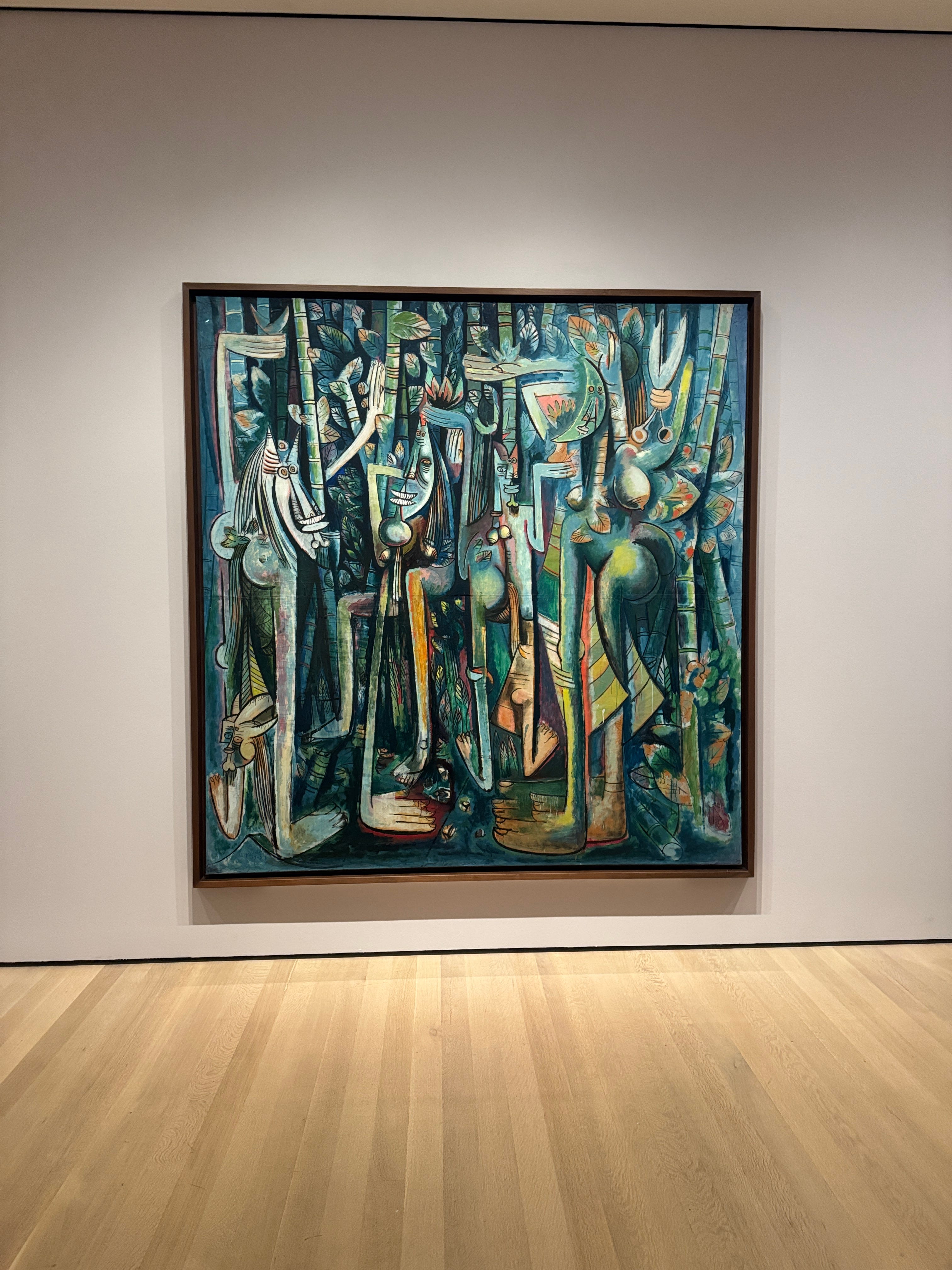
Lam starts to talk about taking the sophisticated language of European modernism and using it as a Trojan Horse to smuggle black truths into the art world.
He is hyper-prolific in this goal, producing a stream of paintings, thinning his oil to where it’s translucent like a watercolor, layering ghost figures over and above each other. Lam begins mixing humanity and beast, embedding ancient ritual in his paintings. It also helps him to use oil on thinner paper when his access to canvas is limited.
Humbled at home without money or proper tools, Lam somehow finds international fame.
There are a lot of reasons Lam’s story pushes my buttons. If you know Cuba, even now, it is built of resilient Macgyvers who make Lemonade without even the lemons. One of the first things anyone mentions about Cuba is its ancient cars, but having spent a lot of time there it’s important to note: Cuba doesn’t have a Pep Boys. Cuba’s highways are traveled almost exclusively by classic antique cars rigged together with string cheese and applesauce, not pampered Sunday cars you find under a tarp, but eternal full-time workhorses that have run non-stop every day for 70+ years. Hundreds of thousands of miles if the odometers could even go that high. They aren’t maintained out of pride, but out of necessity. Without these cars, most Cubans can’t work. And no one in Cuba can afford not to work.
It is also a story about a guy who uses his art almost exclusively to exorcise demons. Be those demons the government, corruption or his own battered soul. At his lowest point, having abandoned the prestige and respect of the art set, without access to any of the materials he learned to use there, Lam doesn’t slow down. When making art is hardest, Lam paints the most he’ll ever paint in his career. He abandons the easy money, eschews the relative ease of using the muscles he trained in school to invent his own means of expression, even when it’s likely to land him in a ditch. Wifredo Lam was a successful artist, but that’s not his fault. He wasn’t painting for those people. Maybe that’s why he appealed to them.


I absolutely love this one, man.